Using PrepVault
How to use the question bank
There are two kinds of interview prep. The kind where you read questions and feel prepared, and the kind where you actually practice answering them out loud or in writing until the structure is automatic. The question bank is built for the second kind.
Here's how each mode works and when to use it.
Flashcard mode
Flashcard mode is for building recall. You're shown a question, you formulate your answer in your head or say it out loud, then you flip the card to see the model answer and rate how well you did.
Use this when you're learning new material, like behavioral frameworks or technical concepts you don't have confident examples for. It works best in short sessions of ten to fifteen minutes, a few times a week. Cramming a hundred flashcards the night before an interview is not the same as spaced repetition over two weeks. The difference shows.
You can create your own decks from job-specific skills when you parse a JD. PrepVault generates flashcards from the skills and topics identified in the role. These are more useful for technical concepts than for behavioral prep, since behavioral answers need to be specific to your experience.
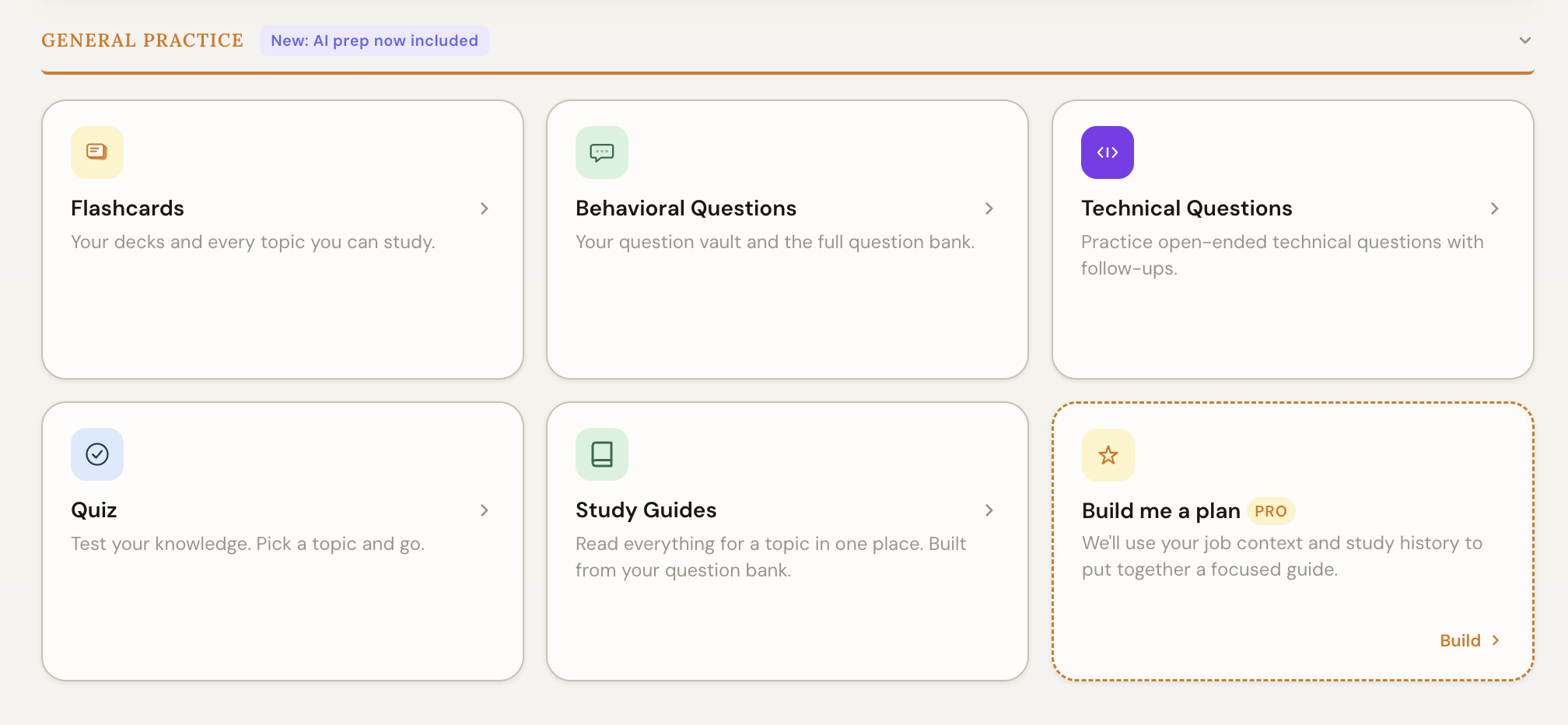
Quiz mode
Quiz mode is time-pressured. You get a question, you have a limited window to answer, and you move on. This is closer to how actual interviews feel.
Use it when you already know the material and want to practice under pressure. If you're not confident in the content yet, quiz mode mostly shows you that you're not ready, which isn't useful feedback. Get the flashcards right first, then stress-test with quiz mode.
The timer is harder than it looks on the first few rounds. That's intentional. Interview time pressure is real, and if you can answer clearly under quiz conditions, you'll answer clearly in the actual interview.
Behavioral practice
Behavioral practice is for STAR-format answers. You get a question like "Tell me about a time you had a conflict with a coworker" and you write your answer. PrepVault scores it against the STAR framework: situation, task, action, result.
This is the mode to use seriously. Most people practice behavioral questions by reading them, nodding, and thinking "yeah I could answer that." Writing the answer forces you to confront whether you actually have a specific story for it and whether that story is complete.
Work through the full behavioral question bank before your first phone screen. Not all of it in one sitting, ten to fifteen questions at a time over a few sessions. By the time you're in a final round, the major categories (conflict, leadership, failure, collaboration) should have answers you've written out, edited, and know cold.
Your personal answer vault
The answer vault is where good answers go so they don't disappear. When you write a behavioral answer that works, a specific story about a hard project or a conflict you navigated, you can save it to the vault.
The vault is searchable. Before an interview, search for the company name or the role type and pull the answers most relevant to that specific job. You're not memorizing scripts. You're having your best material available when you need it, not scattered across notes you can't find.
The practical habit: after any interview, add any answer that landed well to the vault before you forget the specifics. The detail fades fast.
Quick reference
- Flashcards
- Learning new material. Spaced repetition, not night-before cramming.
- Quiz mode
- Stress-testing what you already know under time pressure.
- Behavioral
- Writing out STAR answers forces you to actually have them.
- Answer vault
- Save answers that work. Search before interviews.