Using PrepVault
Anyone can claim a skill. Here's how you earn one.
Every resume says Advanced. Every LinkedIn profile has skill bars the owner clicked themselves. Hiring managers know this, which is why a self-declared level carries roughly zero weight with anyone reading it. Including, if you're honest, you.
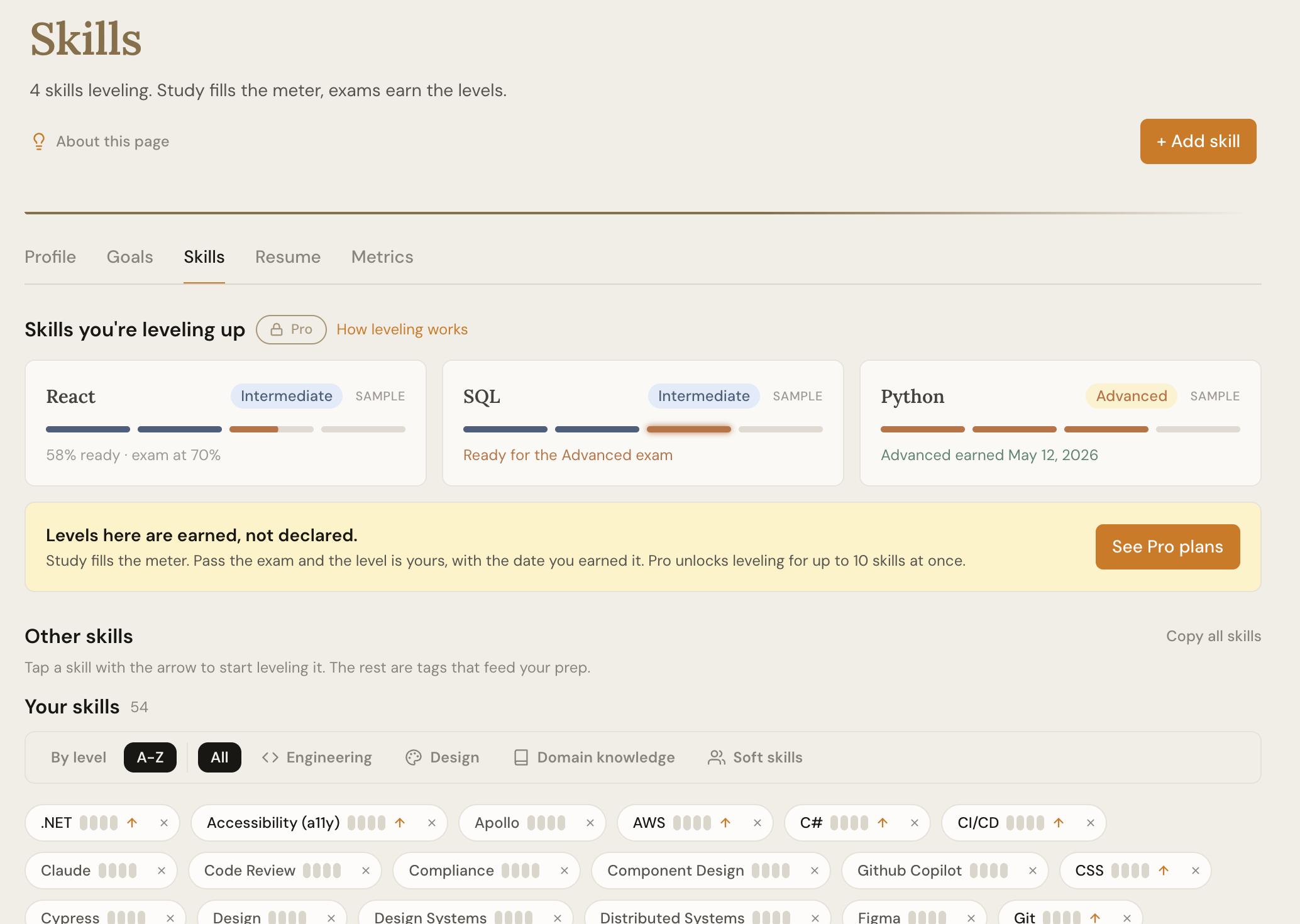
PrepVault takes the opposite approach. Tag yourself with any skill you want, that part is free and feeds job matching. But a level has to be earned. Here's how the system works and how to climb it without wasting study time.
Why a declared level is worth nothing
Think about what "Intermediate React" means when you typed it yourself. It means you felt intermediate that day. Maybe you were being modest. Maybe you were three tutorials in and optimistic. Nobody can tell the difference, and neither can you six months later.
An earned level is different in one specific way: there was a bar, and you cleared it on a date. When PrepVault says you're Advanced, it means you passed a 15-question exam at Advanced difficulty, scoring at least 80% (85% in stricter professions). Every level works this way, including Beginner. There are four: Beginner, Intermediate, Advanced, Expert.
That changes how you walk into an interview. You're not hoping you still know it. You checked, recently, against a real bar. The difference between those two states at 9am on interview day is enormous.
The meter is an honest answer to "am I ready?"
The worst part of studying for anything is not knowing when to stop. The readiness meter exists to answer that one question.
It fills from three study signals: flashcard recall, quiz accuracy, and your confidence on technical questions at the target level. Only completed sessions count, so abandoning a quiz halfway moves nothing. And the signals are capped, which means no single study mode can fill the meter alone. You can't flashcard your way to a number that lies to you.
When the meter hits 70%, the exam unlocks. Below that, the skill card points at the single most useful next step instead of a vague "keep practicing."
How to climb without wasting time
The three study modes measure different things, so rotate rather than camping in one. Flashcards build raw recall. Quizzes check whether you can pick the right answer with a little pressure on. Technical questions are slower work: you reason through a real scenario, then rate your own confidence, which is much closer to what an interview asks of you.
The practical move is simple. Open the skill, look at which signal bar has the most room, and do that. The primary practice button already points at it.
If you fail the exam, you see which topics your misses came from, and the exam reopens in 48 hours. Spend the two days on those topics specifically. The cooldown isn't punishment. It blocks the retake-until-lucky pattern that would make every credential in the system meaningless, yours included.
Already know the skill? Prove it once
If you've been writing SQL for eight years, nobody is making you grind up from Beginner. Tap a skill you've tagged and claim the level you actually hold. You get one placement exam at that level.
Pass and the level is yours, dated, same as any earned level. Fail and you start at Beginner with nothing lost except the claim. One shot is the point. A placement you could retry until it stuck wouldn't prove anything.
What the credential does for your search
Every level you pass writes a dated entry, like "Advanced React, earned June 11, 2026." The date matters more than it looks. "I tested at Advanced level three weeks ago" is a concrete thing to say in an interview, and a concrete thing to hold onto when the doubt shows up the night before.
Shareable badges are coming, so a credential will be able to live on a profile or in an application instead of only inside the app. The earning system was built first on purpose. A badge anyone can click into existence is decoration. A badge with an exam behind it is evidence.
One more quiet benefit: skills compare canonically, so a job asking for "React.js" matches your "React" without you doing anything. Your skill list, leveled or not, is already working in job matching on every tier. Leveling itself is a Pro feature.
Quick reference
- Levels
- Beginner, Intermediate, Advanced, Expert. Every one earned by a 15-question exam.
- The bar
- 80% to pass, 85% for strict professions. Fail and the exam reopens in 48 hours.
- Unlock
- Readiness meter at 70%, built from completed study sessions only
- Placement
- One shot to prove a skill you already own. Fail it and you start at Beginner, nothing lost.
- Tiers
- Tags and job matching are free. Leveling is Pro.